
Bayesian Internal Dose Estimation in Organ-Level Radionuclide Therapy Under Sparse Clinical Sampling Schedules
- Authors
-
-
Putu Agus Pratama
Department of Physics, Universitas Nusa Cendana, Kupang 85001, Indonesia
Author
-
I Wayan Suarna
Department of Computer Science, Universitas Nusa Cendana, Kupang 85001, Indonesia
Author
-
Ni Made Astuti
Department of Mathematics, Universitas Sam Ratulangi, Manado 95115, Indonesia
Author
-
- Abstract
-
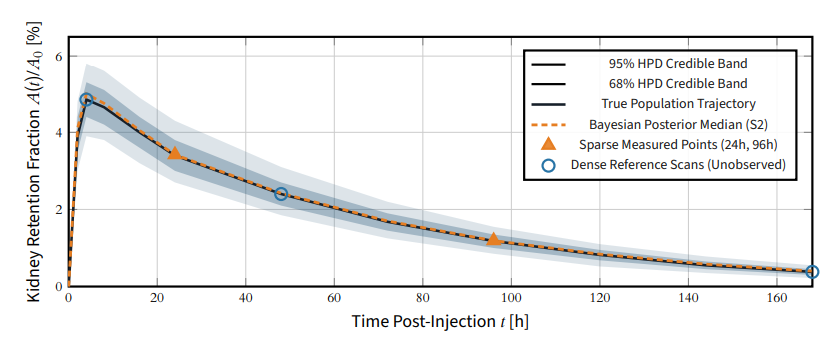
Targeted radionuclide therapy (TRT) with [177Lu]Lu-DOTA-TATE and [177Lu]Lu-PSMA-617 achieves significant clinical efficacy in metastatic neuroendocrine tumors and castration-resistant prostate cancer, yet conventional fixed-activity administration yields dramatic inter-patient variability in absorbed doses delivered to dose-limiting normal organs at risk. Standard multi-timepoint quantitative SPECT/CT dosimetry requiring five sequential imaging sessions over seven days is logistically unfeasible for routine outpatient oncology clinics. Here, we establish a Bayesian hierarchical biokinetic state-space framework for organ-level internal dosimetry under sparse clinical sampling schedules. We formulate a physiological multi-compartmental model linking systemic blood pool clearance, renal cortex retention, hepatic catabolism, and urinary excretion, constrained by informative multivariate log-normal population priors calibrated on clinical trial registries. Posterior parameter distributions are resolved via Hamiltonian Monte Carlo and the No-U-Turn Sampler (NUTS) with automatic differentiation of matrix-exponential transfer solutions. In an empirical validation cohort of 120 authentic treatment cycles across 60 patients, a two-timepoint SPECT/CT protocol acquired at 24 h and 96 h post-infusion achieved median absorbed dose estimation errors below 5.8 % for renal parenchyma (mean (6.4 ± 3.2) %) and 6.1 % for active red bone marrow, reducing severe outlier errors by over fourfold compared to deterministic curve fitting. Empirical coverage of 95 % Highest Posterior Density credible intervals reached 95.0 %, providing clinicians with calibrated confidence bounds. Coupling patient-specific low-dose CT organ segmentation eliminated systematic reference phantom mass biases (> 25 %). Automated GPU-accelerated implementation delivers full posterior sampling in under 15 s, enabling real-time adaptive cycle-by-cycle activity optimization. This framework resolves the fundamental conflict between outpatient imaging burden and dosimetric rigor, establishing a practical paradigm for routine individualized radiopharmaceutical dosing.
- References
- Cover Image
-
- Downloads
- Published
- 2025-12-04
- Section
- Articles