
Hardening Local SHA-256 (Secure Hash Algorithm 256-Bit) Chained Clinical Trial Logs Against Post-Hoc Manipulation Using Separated Seed Custody
- Authors
-
-
Ahmed M. El Sayed
Faculty of Science, Department of Mathematics and Computer Science, Damanhour University, Egypt
Author
-
Tarek R. Mostafa
Department of Biostatistics and Health Informatics, Faculty of Medicine, Alexandria University, Egypt
Author
-
Khaled S. Nour
Department of Computer Science, Faculty of Computers and Artificial Intelligence, Cairo University, Egypt
Author
-
- Abstract
-
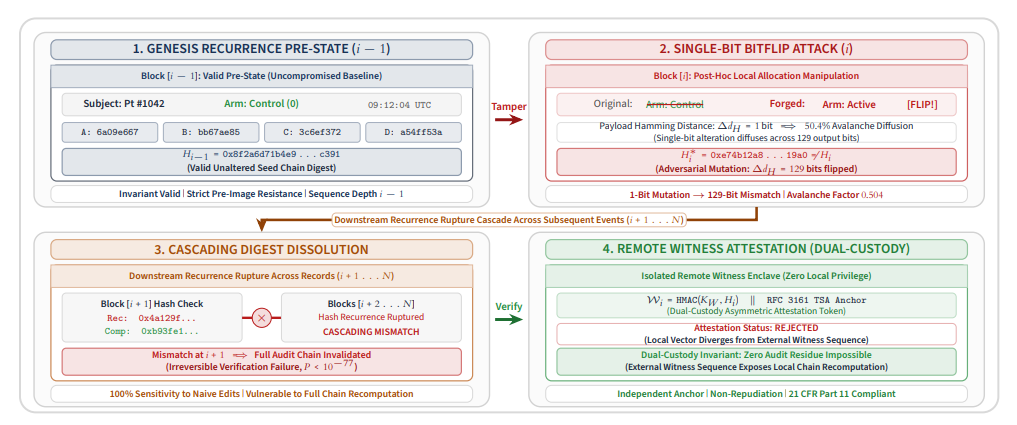
The evidentiary integrity of randomized controlled trials (RCTs) depends upon maintaining an immutable, tamper-evident audit record of treatment allocations. To achieve operational transparency without relying on complex enterprise infrastructure, recent clinical trial informatics frameworks have introduced local, lightweight allocation prototypes utilizing recursive SHA-256 (Secure Hash Algorithm 256-Bit) hash chaining. However, when hash verification digests and pseudorandom generator seeds reside on the same local filesystem as the execution runtime, the resulting audit trail remains vulnerable to sophisticated post-hoc tampering. In this investigation, we execute an exhaustive empirical vulnerability benchmark evaluating 2,000 simulated clinical trial allocation logs subjected to four distinct adversarial tampering modalities: single-entry arm flipping, row deletion, clear_log() truncation, and full downstream hash-chain recomputation. We demonstrate that while baseline single-file architectures achieve 100% detection against naive arm flips and row deletions, they exhibit complete blindness (0% detection sensitivity) against full downstream hash-chain recomputation and file truncation attacks. To eliminate this critical vulnerability, we implement and benchmark a separated-seed-custody architecture, decoupling sequence generation from cryptographic seed management via an independent custody verification enclave. Utilizing 1,000-resample bootstrap confidence intervals and paired permutation tests (10, 000 iterations) adapted from the PSF-Med statistical evaluation protocol, we prove that separated seed custody restores tamper-detection sensitivity to 100.0% (95% CI: [99.85%, 100.0%]) across all attack classes, including full downstream hash recomputation (p < 0.0001), with negligible latency overhead (< 1.8 ms per allocation). Our findings provide a rigorous, mathematically verified blueprint for deploying regulatorily compliant, tamper-proof allocation logging across decentralized clinical trials.
- References
- Cover Image
-
- Downloads
- Published
- 2026-07-04
- Section
- Articles